
ABDM Connector That Takes Your Software Live in a Week
We put your HMIS, EMR, lab or telemedicine product on India’s ABDM network through 9 developer endpoints. ABHA, Scan and Share, consent and FHIR R4 exchange run on our M1, M2 and M3 integration, certified by NHA. Your team avoids the six-month build, the sandbox exit and the security audit.
Why In-House ABDM Integration Stalls Product Roadmaps
A direct ABDM build pulls your best engineers into a long project whose specification shifts underneath them. The certification route usually costs more time than the coding.
What a direct build must clear before one live transaction
- Milestone build: every M1, M2 and M3 flow passing inside the ABDM sandbox.
- Functional testing: test cases verified by an NHA-empanelled testing agency.
- WASA audit: a web application security assessment by a CERT-In empanelled auditor.
- Sandbox exit: a workflow demo to the NHA panel before production keys arrive.
A gateway of 40+ calls and a dozen callback chains
ABHA, record linking, consent and data transfer each run their own callback chains. Your team codes against specifications that NHA revises often.
Certification gates that add weeks
Functional testing, the WASA audit and the NHA demo run one after another. A single failed test case sends you back a step.
Three to six months before launch
A ground-up build usually needs a full product cycle before production keys arrive. Your strongest engineers spend it on plumbing.
Maintenance that never ends
Gateway version changes, FHIR profile updates and new test cases keep arriving. Every change pulls engineers back from your own roadmap.
Meet the VCDoctor ABDM Connector
Our custom ABDM integration builds ABDM into your own code. When you need ABDM sooner, the VCDoctor ABDM connector is a ready API layer between your software and the ABDM gateway. Your engineers call 9 endpoints, and the connector handles sessions, callbacks, encryption, consent artefacts and FHIR bundles.
M1, M2 and M3 from launch
Your platform transacts on our NHA-certified integration across all three milestones from the first day live.
9 simplified APIs
ABDM’s gateway is condensed into 9 clean endpoints, with sandbox access and integration documentation provided at kickoff.
Zero health data storage
Records pass through encrypted channels and are never stored by the connector. Your data governance stays simple.
Compliance, fully managed
When NHA revises APIs, test cases or FHIR profiles, we update the connector. Your code stays unchanged.
Everything the ABDM Connector Handles in Your Workflow
Eight workflows cover what ABDM expects from a compliant platform. Each one plugs into screens your staff already use.
ABHA Creation and Verification
Create a 14-digit ABHA number or verify an existing ABHA address during patient registration. Aadhaar OTP, mobile number and driving licence routes all work.
- Front-desk ready: runs inside your existing registration screen.
- Verified demographics: name, age and contact details flow into the patient record.
- ABHA card: downloadable for the patient on request.
Scan and Share Registration
Patients scan your facility QR code with any ABHA-enabled app and share their profile in seconds. Your desk receives it and issues a token without manual typing.
- Facility QR: provisioned against your HFR ID.
- Fewer entry errors: verified details replace hand-typed forms.
- Shorter queues: registration moves from the counter to the patient’s phone.
Link Patient Health Records
Every OPD visit, admission, lab result or prescription becomes a care context linked to the patient’s ABHA address. Patients can also discover past records from their PHR app.
- Provider-initiated linking: records link the moment they are created.
- Patient-initiated linking: patients find and link older records themselves.
- Link notifications: patients are told when a new record joins their ABHA.
Manage Patient Consent
Consent requests, grants, denials, expiries and revocations are routed through the consent manager that ABDM operates. Every consent artefact is validated before a single record moves.
- Purpose and time bound: data is shared only for the approved purpose and date range.
- Revocation handling: access stops when a patient withdraws consent.
- Audit trail: each consent event is logged for review.
Share Digital Health Records
When a valid consent arrives, the connector builds FHIR R4 bundles to the NRCeS implementation guide. It then encrypts each bundle and delivers it to the requester.
- Eight record types: prescription, diagnostic report, OP consultation, discharge summary, immunisation, wellness, health document and invoice.
- Start simple: share PDF-backed bundles first, then move to fully coded data.
- End-to-end encryption: ECDH key exchange with AES-GCM, as ABDM requires.
Fetch Records With Consent
Your doctors request a patient’s history from any ABDM-linked facility. The patient approves on their ABHA app, and records arrive decrypted inside your system.
- Request from the consult: consent requests are raised from the clinician’s screen.
- Multi-facility history: pulls records from hospitals, clinics and labs.
- Better-informed visits: prior results are visible before new tests are ordered.
View Linked Records in Your System
Fetched records render as readable timelines inside your EMR or HMIS. Clinicians see dates, sources and record types without leaving their workflow.
- Organised display: grouped by encounter, record type and facility.
- Consent-aware storage: fetched data is cleared when the consent period ends.
- Your interface: you decide how fetched records appear in your own screens.
Facility and Software Linkage
Each facility links to its ABDM software once, through the Software Linkage option on the HFR portal. We guide your facility manager through every step.
- HFR ID required: each facility needs an approved Health Facility Registry ID.
- HPR sign-in: the facility manager logs in with a Healthcare Professional ID.
- No HFR yet: we handle HFR registration and HPR registration for you.
Choose How Your ABDM Connector Goes Live
Both connector options sit next to a direct build, so the trade-offs are plain to see. Every route ends in live ABDM traffic, while speed, effort and ownership differ.
Direct ABDM Integration
Your team codes against 40+ gateway calls and 12+ callback chains in-house. Functional testing and a CERT-In empanelled WASA audit follow, then sandbox exit and production keys in your company’s name.
Plug In and Transact
Wire up 9 endpoints while our engineers stay on call. Your software skips the sandbox exit and the WASA audit, and transacts from launch on our certified M1, M2 and M3 credentials. The connector acts as your gateway.
Full Credential Ownership
Run the same 9 endpoints as middleware inside your product. With our guidance, you complete functional testing and the WASA audit, clear sandbox exit and transact under credentials issued to you.
Starting on Option 1 does not lock you in. The endpoints stay identical, so switching to your own credentials later needs no rework.
Want ABDM Live Before Your Next Release?
Spend 30 minutes with our ABDM engineers. You leave with your milestone scope, an integration walkthrough and a go-live date you can plan around.
One Connector for Every Kind of Health Software
Any product that creates or reads patient records in India can plug into the ABDM connector. Each tile shows the milestones ABDM typically expects from that software type.
Hospital Management Systems
Identity, record sharing and record fetch across OPD, IPD and discharge.
EMR and EHR Software
Clinic and specialty records linked to ABHA and shared with consent.
Telemedicine Platforms
Virtual consults that create, link and fetch records like any clinic.
Lab Information Systems
Lab reports pushed to the patient’s ABHA as diagnostic report records.
Radiology and Imaging
Imaging reports shared as FHIR diagnostic reports with attachments.
Pharmacy Software
Dispensing and invoice records linked to the patient’s ABHA address.
PHR and Health Locker Apps
Consumer apps that issue ABHA addresses and manage patient consents.
Insurance and TPA Platforms
Consent-based access to the records that support a claim.
Milestone scope follows ABDM’s sandbox guidance for each software type. We confirm your exact scope during the demo.
Use the ABDM Connector or Build Custom?
Let this quarter’s biggest priority decide.
Go With the Connector
When launch speed and lean engineering matter most- Launch within days: roughly one week when you use our credentials.
- Small build effort: nine endpoints rather than the whole gateway.
- Hands-off upkeep: specification changes never reach your code.
- Clear quote: priced on your software type and transaction volume.
Go Custom
When ABDM must live deep inside your own modules- Native experience: ABDM screens designed into your existing modules.
- Your own certificate: NHA certifies your product directly.
- Specialised records: bespoke FHIR mapping for unusual data models.
- Longer runway: plan for roughly two to three months to production.
A hybrid also works. Use the connector for identity and consent traffic, and commission custom screens around it. We map that split with you during the demo.
How the Seven-Day Rollout Runs
This schedule assumes Option 1, where you transact on our certified credentials. Larger platforms may need a few extra days.
Before day one: each facility needs an approved HFR ID and a facility manager with an HPR ID. No HFR yet? We run HFR registration and HPR onboarding alongside your integration.
Day 1
Scoping Call and Test Keys
We agree your milestone scope on a short call. Test credentials and developer guides land in your inbox that afternoon.
Days 2 to 4
Build Against 9 Endpoints
Your developers connect registration, linking, consent and record exchange. Our engineers answer questions in real time.
Day 5
Dry Run in the Sandbox
Every flow is exercised with test patients and test records, so defects surface before real data moves.
Days 6 and 7
First Real Patient
Each facility completes Software Linkage on the HFR portal. Your front desk then registers its first real ABHA patient.
Facility readiness and product complexity can stretch this plan. Choosing Option 2 extends it by one to three months for audit and sandbox exit.
ABDM runs inside our own platform, not just our clients’
The same identity, consent and exchange layer powers VCDoctor every day.
Why Teams Trust VCDoctor for ABDM
We run ABDM on our own platform first. That experience goes into every connector deployment.
Our own platform runs on ABDM
VCDoctor is ABDM integrated, with ABHA identity, consent-based sharing and registry linkage. Read the VCDoctor ABDM integration case study.
One partner for every ABDM registry
ABHA, HFR, HPR and consent flows sit with one team. Explore our ABHA-enabled healthcare solution for the patient side.
Privacy built into the data path
Pass-through architecture, encrypted exchange and consent logs support your DPDP Act compliance obligations.
Backed by 22+ years in healthcare IT
VCDoctor is built and supported by DreamSoft4U, with 1,600+ projects delivered and 100+ engineers on call.
Put ABDM in Front of Your Users Within Days
Bring one question or your full roadmap. Our engineers show the connector running, confirm your milestone scope and hand you a rollout plan your team can act on.
Frequently Asked Questions
Viewer’s Favourite Blogs
Discover expert insights, technology guides, and regulatory updates in digital healthcare solutions.
ABDM Integration Checklist: M1, M2 and M3 Steps for Healthcare Providers
ABDM vs HFR vs HPR: Everything You Need to Know
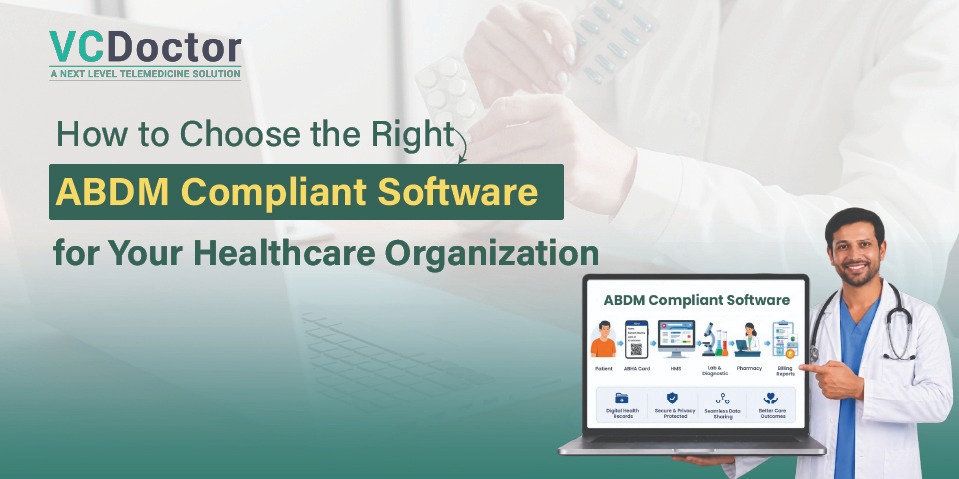
How to Choose the Right ABDM Compliant Software for Healthcare