

ABDM vs HFR vs HPR: Everything You Need to Know in 2026
As healthcare becomes more digital, terms like ABDM vs HFR vs HPR are becoming increasingly common. However, many healthcare professionals and organizations still struggle to understand the difference between them.
While they are often mentioned together, each serves a different purpose. Understanding how they fit together is essential for healthcare providers, hospitals, clinics, and digital health companies.
So, if you’re planning for ABDM-compliant software but are confused by the acronyms, this guide is all you need.
In this guide, you will learn:
- What ABDM, HPR, and HFR each do
- How the three differ side by side
- How ABHA and PHR fit in
- Common misconceptions to avoid
- How to get ABDM-ready step by step
By the end of this guide, you will understand everything about ABDM vs HFR vs HPR. You will know what to register, in what order, and what your software must support.
ABDM vs HFR vs HPR at a Quick Glance
Here is the quick overview on ABDM vs HFR vs HPR:
| Term | What it is | What it covers | Unique identifier |
|---|---|---|---|
| ABDM | The national digital health framework run by the NHA | The whole ecosystem, its standards, and protocols | None, it is the network itself |
| HPR | A verified registry of health professionals | Doctors, nurses, dentists, and paramedics across modern and AYUSH systems | HPR ID |
| HFR | A registry of health facilities | Hospitals, clinics, labs, pharmacies, blood banks, public and private | HFR facility ID |
What Is ABDM (Ayushman Bharat Digital Mission)?
ABDM is the umbrella framework from the National Health Authority that digitises Indian healthcare. It is not an app you install. It is the set of standards, registries, and protocols behind secure, consent-based record exchange.
Think of the ABDM as the rails. It defines how patients are identified through ABHA, professionals through HPR, and facilities through HFR.
Everything practical sits on top, including your hospital system, your EHR, and your telemedicine platform. ABDM simply gives them a common language to talk to each other.
What Is HPR (Healthcare Professionals Registry)?
HPR is the verified directory of licensed health professionals. It ensures only qualified practitioners appear in the digital health ecosystem, which protects patients. Doctors, nurses, dentists, and paramedics across modern and AYUSH systems can register.
Each verified professional receives a unique HPR ID. That identity lets a doctor digitally sign records, issue ABDM-linked prescriptions, appear in patient searches, and reach services such as e-Sanjeevani.
The registration belongs to the person, not the workplace. A doctor at two clinics holds one HPR ID, and each facility links to it, even for a remote telemedicine appointment.
What Is HFR (Health Facility Registry)?
HFR is the national directory of healthcare facilities. It covers public and private establishments alike, from hospitals and clinics to labs, imaging centres, pharmacies, and blood banks. Registration is voluntary and takes about 20 to 30 minutes.
Each facility gets a unique HFR ID. That ID makes it discoverable on a national platform and lets it integrate with ABDM-compliant systems. It also smooths empanelment paperwork that once took weeks.
If HPR answers who is treating you, HFR answers where. A clinic with three doctors holds one HFR entry, with each doctor linked through their own HPR ID.
Also Read: An Ultimate ABDM Integration Checklist for Healthcare Providers
Still figuring out where to start with ABDM compliance?
Book a free 30-minute consultation with our experts to get clear, practical guidance with no sales pressure.
Schedule a MeetingABDM vs HFR vs HPR: Key Differences
Here’s the head-to-head comparison between ABDM vs HFR vs HPR:
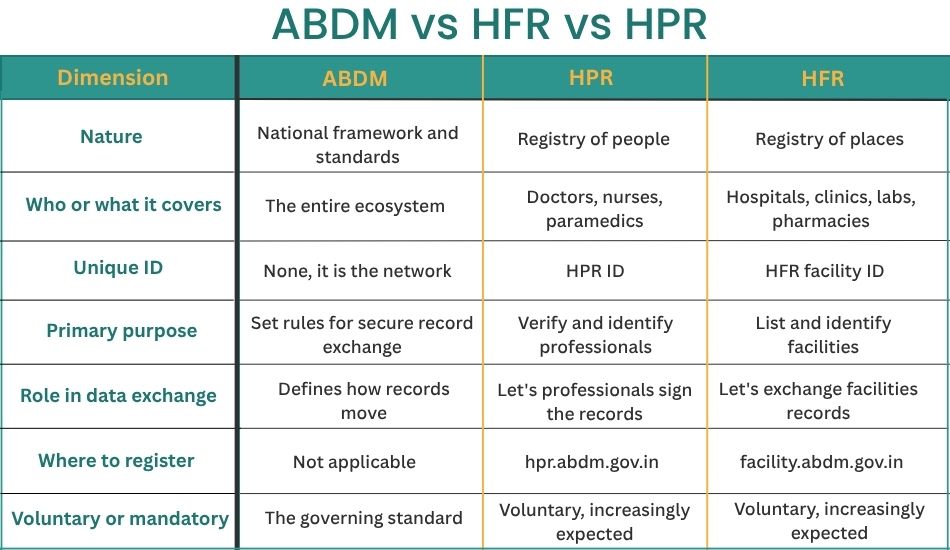
1. Nature
ABDM is India’s national digital health framework. It establishes the standards, protocols, and infrastructure that enable secure health data exchange across patients, healthcare providers, and digital health platforms.
HPR is a verified registry of healthcare professionals. It creates trusted digital identities for doctors, nurses, dentists, AYUSH practitioners, and other licensed providers participating in the healthcare ecosystem.
HFR is a national registry of healthcare facilities. It maintains a verified directory of hospitals, clinics, laboratories, pharmacies, blood banks, and other healthcare establishments.
2. Identity Focus
ABDM does not represent an individual or organization. Instead, it provides the framework through which healthcare professionals, facilities, and patients can be identified and connected digitally.
HPR focuses on individual healthcare professionals. Every verified practitioner receives a unique HPR ID that confirms their qualifications and professional identity across the ecosystem.
HFR focuses on healthcare organizations. Every registered facility receives a unique HFR ID that serves as its official digital identity within ABDM-enabled services.
3. Trust and Verification
ABDM builds trust by defining standardized rules for identity verification, consent management, privacy, and secure health information exchange across participating entities.
HPR verifies the credentials, registrations, and qualifications of healthcare professionals. This helps patients and healthcare organizations confirm that a practitioner is genuine and authorized to provide care.
HFR verifies healthcare facilities and their operational details before listing them in the national directory. This improves transparency and helps patients identify recognized healthcare providers.
4. Role in the Healthcare Ecosystem
ABDM acts as the connecting layer of India’s digital healthcare ecosystem. It enables different healthcare systems and software platforms to exchange records using common standards.
HPR represents the professionals delivering care. It links consultations, prescriptions, diagnoses, and clinical records to verified healthcare practitioners.
HFR represents the facilities where care is delivered. It allows hospitals, clinics, and diagnostic centers to participate in digital health services and health record exchange.
5. Portability and Usage
ABDM functions as a nationwide framework that remains the same regardless of which hospital, clinic, or software platform is being used.
An HPR ID belongs to the healthcare professional and remains valid throughout their career. The same ID can be used across multiple hospitals, clinics, and telemedicine platforms.
An HFR ID belongs to a specific healthcare facility and remains associated with that organization. Unlike an HPR ID, it stays tied to the facility rather than moving with an individual.
Now that you have the ABDM vs HFR vs HPR view side by side, let us see how the three move a patient’s records in a real visit.
How ABDM, HPR, and HFR Work Together?
This is where ABDM vs HFR vs HPR stops being abstract. In a real visit, the receptionist scans the patient’s ABHA address. The software then requests prior records through ABDM, and a consent prompt reaches the patient’s phone.
The patient approves, and past reports, prescriptions, and summaries flow in. The doctor, known by their HPR ID, reviews the history and writes a signed prescription. The facility, known by its HFR ID, pushes that record back for the next provider.
Adoption is already large. Official figures put ABHA health IDs above 68 crore, with over 3 lakh facilities on HFR and 5 lakh professionals on HPR, per National Health Authority data.
4 Common Misconceptions About ABDM, HPR, and HFR
Most confusion around ABDM vs HFR vs HPR comes from a few myths that spread faster than facts. Clearing them saves you from costly wrong turns.
1. ABDM Is Just Government Health Insurance
People blur ABDM with the Ayushman Bharat insurance scheme because they share branding. They are separate things. ABDM is an infrastructure that moves records, while the insurance scheme pays for treatment.
2. ABDM Compliance Is a Simple Yes or No
Compliance is a spectrum, not a switch. Creating an ABHA for a patient is one small rung, while full consent-based exchange across HPR, HFR, and ABHA is a far higher one.
3. Saving an ABHA Means You Are Using ABDM
Storing an ABHA number is not the same as joining the network. Without consent management and exchange, you have merely copied an ID into a field. Value appears only when records flow.
4. HPR and HFR Are Two Names for the Same Thing
This is the ABDM vs HFR vs HPR mix-up in its purest form. HPR registers people, and HFR registers places. A doctor needs an HPR ID, while the building needs an HFR ID.
Why HPR and HFR Matter for Providers and Patients?
Treat HFR and HPR as a team rather than rivals, and the payoff shows on both sides of the consultation.
- Discoverability: Registered doctors and facilities appear when patients search the national platform, which widens reach without paid marketing.
- Trusted prescriptions: An HPR ID lets professionals issue ABDM-linked, digitally signed prescriptions that carry across the ecosystem.
- Scheme eligibility: HFR registration eases access to government empanelment and programmes that favour listed facilities.
- Patient confidence: People verify a provider’s credentials and a facility’s legitimacy before they ever walk in.
To turn these registries into daily outcomes, providers lean on an ABDM-ready telemedicine and HMIS platform that handles the heavy lifting.
Now that the value is clear, let us walk through how you actually get ABDM-ready, one step at a time.
How to Get ABDM-Ready: HPR, HFR, and Software Integration? 4 Steps
Follow these four steps in order, and you move from confused to connected without backtracking.
Step 1. Check Your Eligibility and Keep Your Documents Ready
Start by confirming you qualify, which saves a stalled application later. Any practitioner registered with a recognised council can join HPR, including doctors, nurses, dentists, and paramedics from modern and AYUSH systems. On the facility side, both public and private establishments follow the same path.
Now gather your paperwork before you log in, since the portal asks for it midway. For HPR, keep your Aadhaar or driving licence for KYC, your council registration number, and a clear photo of the certificate. For HFR, keep your facility, ownership, and service details ready.
Step 2. Register on HPR and Collect Your HPR ID
Head to hpr.abdm.gov.in and choose to create your Health Professional ID. Verify your identity with an Aadhaar OTP, then fill in your personal, academic, and professional details exactly as they appear on record. Accuracy matters because the council verifies what you enter.
After you submit, the relevant board reviews and confirms your credentials. Once approved, you receive your unique HPR ID, usually formatted like 91-XXXX-XXXX-XXXX, by SMS and email. That single ID now travels with you everywhere you practise.
Step 3. Register Your Facility on HFR
Log in at facility.abdm.gov.in as a facility administrator and search for your establishment. If it already exists, you claim it, and if it does not, you add it as a new facility. The system guides you through ownership and type.
Next, fill in your infrastructure, services, and location details, then submit for verification. Most facilities finish in about 20 to 30 minutes when their information is ready. Once cleared, your facility holds a unique HFR ID.
Step 4. Choose ABDM-Compliant Software and Go Live
Registration gets you listed, but software is what makes the network usable. Pick a platform that supports every ABDM module: M1 for HPR onboarding, M2 for HFR onboarding, and M3 for ABHA creation and consent-based exchange. A missing module becomes a failed data-sharing gap later.
Before you go live, test every workflow in the NHA sandbox, then move to production once it behaves correctly. A good vendor retrofits your current EHR rather than forcing a rebuild. Your ABDM vs HFR vs HPR setup then runs quietly while your staff keeps their routine.
Read Also: How to Choose the Right ABDM Compliant Software
Why Consider VCDoctor for ABDM, HPR, and HFR Integration?
VCDoctor is a white-label telehealth and HMIS platform engineered to plug ABDM into the software you already run. We map your EHR or hospital system and add registry support on top, with no disruptive rebuild.
- Full registry coverage: We handle ABDM, HFR, and HPR integration end to end, with M1, M2, and M3 working as one.
- Compliance by design: HIPAA, GDPR, NABIDH, DHA, and ABDM standards are built into the platform, not bolted on.
- Zero rebuild: We retrofit your existing EHR or HMS, so there is no downtime and no staff retraining.
- Proven across regions: Hospitals and clinics across India, the US, and the UAE run on our platform, as our case studies show.
Ready to Go ABDM-Compliant Without Starting from Scratch?
Our experts help you onboard professionals, register facilities, and enable secure health data exchange through a single integrated platform.
Contact Us TodayConclusion
ABDM vs HFR vs HPR may sound similar, but they serve different purposes.
ABDM is the framework that connects the ecosystem, HPR identifies healthcare professionals, and HFR identifies healthcare facilities.
Together, they make secure and seamless health data exchange possible.
For healthcare providers, understanding these components is the first step toward ABDM readiness.
Whether you’re a hospital, clinic, or digital health company, adopting the right systems today will help you stay compliant, improve interoperability, and deliver a better patient experience tomorrow.
We hope this guide has helped you clearly understand the role of each component and how they work together.
Now it’s our turn to help. Whether you’re planning HPR and HFR registration or looking for ABDM integration support, the VCDoctor team is here to make the process simple and hassle-free.
FAQs
1. What is the main difference between ABDM, HPR, and HFR?
ABDM is the overall framework, HPR is the registry of verified professionals, and HFR is the registry of facilities. In the ABDM vs HFR vs HPR setup, ABDM is the network while HPR and HFR are two directories inside it.
2. Is HPR registration mandatory for doctors?
It is voluntary today, though adoption is rising and government services increasingly expect it. Without an HPR ID, you cannot issue ABDM-linked prescriptions, so early registration is a practical advantage.
3. Who needs to register on HFR?
Any healthcare facility can register, including hospitals, clinics, diagnostic labs, imaging centres, pharmacies, and blood banks, both public and private. One facility holds one HFR entry, with its professionals linked through their own HPR IDs.
4. What is ABHA, and how does it link to HPR and HFR?
ABHA is the patient’s 14-digit health ID that connects their records across providers. It works with HPR and HFR, so a verified professional at a registered facility can access a patient’s history with consent.
5. Is ABDM registration free?
Yes, creating an ABHA and registering on HPR or HFR carries no fee. Your only real cost is the ABDM-compliant software you choose to run the workflows day to day.
6. How long does HPR or HFR registration take?
HPR registration takes roughly 30 minutes of form-filling, followed by council verification. HFR registration usually wraps up in about 20 to 30 minutes when your facility details are ready in advance.
7. Do I need ABDM-compliant software to use HPR and HFR?
Registration alone gets you listed, but software activates the network. To exchange records, issue digital prescriptions, and manage consent, you need a platform that supports the M1, M2, and M3 modules.