
AI in Healthcare: Features, Benefits, Use Cases, and Future Trends in 2026
AI has revolutionized numerous sectors, including finance and manufacturing. But the benefits of AI in healthcare are driving a significant shift in the industry.
Healthcare organizations, including hospitals, clinics, researchers, and digital health companies, are increasingly adopting AI-powered technologies, telehealth solutions, remote patient monitoring (RPM solutions) and advanced telemedicine software to improve patient care, optimize operations, and support clinical decision-making.
It can now diagnose in seconds, analyze medical images with incredible precision, automate administrative tasks, and identify risk before things become critical.
AI is advantageous for doctors and patients. Doctors receive assistance in diagnosis and planning treatment. Personalized and timely care is received by patients. Workload reduction, improved workflows, and optimal resource allocation benefit healthcare organizations.
However, many organizations are still unaware of how AI is being adopted in healthcare and how it is impacting the healthcare industry.
In this guide, we will learn about what AI looks like in healthcare, how it is used, the benefits of AI in healthcare, the challenges faced, real examples and use cases of AI, and the impact on the future of healthcare.
What is the Role of AI in Healthcare?
In healthcare, artificial intelligence uses algorithms and machine learning models to analyze medical datasets, identify patterns, and support clinical decision-making. It interacts effectively with EMR systems and EHR systems, enabling seamless access to patient history, lab results, and imaging data.
It can analyze health records, medical images, lab results, patient history, and real-time data to find trends and insights that may otherwise go unnoticed by humans.
AI is revolutionizing nearly all areas of healthcare, including research, discovery, diagnostics, treatment, and hospital operations. As such, this will help healthcare systems become more efficient at delivering care to patients and improving the quality of care patients receive.
In the past, healthcare organizations were reluctant to implement AI as a result of cost, privacy, and ethical hurdles. As compliant cloud environments evolve, it becomes easier for providers and a telehealth app development company to build scalable and secure AI-driven healthcare applications.
Have Questions About AI in Healthcare?
Chat with our experts on WhatsApp to explore AI use cases and next steps for your healthcare organization.
Talk to Our ExpertsTypes of AI in Healthcare
1. Machine Learning
Machine learning finds patterns in health data. It helps predict disease risk and patient outcomes. It guides hospitals in resource planning and decision-making. This results in more reliable forecasting and proactive care.
2. Deep Learning
Deep learning uses neural networks to process complex data. It supports urgent triage and sends rapid alerts to clinicians. It improves accuracy in high-pressure situations. This helps reduce diagnostic delays and speeds up treatment.
3. Computer Vision
Computer vision understands medical images using tools like a DICOM viewer. It can detect tumors, fractures, and hidden abnormalities. It helps doctors diagnose earlier and with greater confidence. This leads to faster and more accurate image-based assessment.
4. Natural Language Processing
NLP reads and understands medical text. It processes doctor notes and patient records. It reduces paperwork and ensures important details are not missed. This ensures consistent documentation and better information accessibility.
5. Robotics
Robotics assists in surgery and lab tasks. Surgical robots help with precision and smaller incisions. Lab robots automate repetitive processing with fewer errors. This improves patient safety and operational speed.
6. Generative AI
Generative AI creates new content from learned data. It drafts summaries and documentation. It supports communication and generates training data for research. This reduces administrative load and frees up clinicians to focus on patient care.
Read Also: AI Chatbot in Healthcare
Benefits of AI in Healthcare
Doctors
- More accurate diagnosis: AI studies scans and medical data in detail and helps detect issues much earlier than manual review
- Faster decisions: AI gives real-time recommendations based on the patient’s current status and past medical patterns
- Less admin work: AI handles documentation and updates digital records, which frees doctors to spend more time with patients
- Better patient understanding: AI summarizes the entire patient history in a simple format and highlights the most critical parts
- Smarter patient monitoring: AI observes patient data continuously and warns when early risk signs appear
- Reduced mental fatigue: Doctors rely on AI as a support tool, which reduces cognitive load and helps them maintain better focus.
Hospitals
- Smooth daily operations: AI supports intake and queuing and data management, and internal routing, which keeps systems running steadily
- Reliable planning: AI predicts the number of expected patients and needed beds and required staff for the day or week ahead
- Lower operational cost: Automation removes repeated manual work, which reduces both time waste and human mistakes
- Faster patient movement: Patients pass through check-in and diagnosis, and treatment faster, which improves satisfaction
- Trustworthy documentation: AI maintains clean and consistent patient records that match compliance expectations
- Better overall performance: AI helps the hospital deliver consistent care with fewer errors and stronger efficiency
Patients
- More personalized treatment: AI recommends care based on individual data, which includes medical history and responses to previous treatments
- Quicker results and clarity: AI reviews scans and test results faster, so patients do not wait in uncertainty
- Helpful recovery guidance: AI reminds patients about medication and follow ups and health activities that support healing
- Care from anywhere: Telehealth and remote tracking allow patients to connect with doctors from home or travel
- Earlier risk prevention: AI identifies possible health problems before symptoms become severe
- Higher confidence in care: Patients feel safer knowing that decisions are supported by both medical expertise and AI intelligence
Ready to Explore AI for Your Healthcare Workflow?
Book a live demo with our AI specialist to see practical AI applications for hospitals, clinics and healthtech teams.
Schedule a Meeting NowUse Cases of AI in Healthcare
Here are some main uses of AI in healthcare:
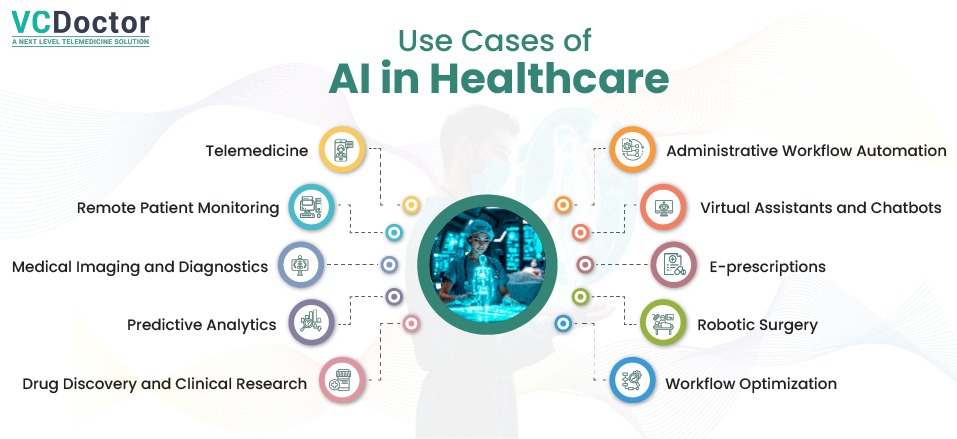
1. Telemedicine
AI in telemedicine analyzes symptoms, voice patterns, and clinical data to enhance virtual consultations. Providers often rely on telemedicine app development solutions to integrate AI-driven triage, documentation, and diagnosis support.
2. Remote Patient Monitoring
AI collects real-time vitals through wearables, including heart monitors and glucose monitors. AI identifies problematic and dangerous patterns emerging, such as declining oxygen levels, and can even identify an irregular heart rhythm. Physicians receive an instant alert that allows management before something progresses into an emergency.
3. Medical Imaging and Diagnostics
AI analyzes scans pixel by pixel. AI can detect early-stage tumors and abnormalities, sometimes faster than a human review. By using AI as a second layer of validation, radiologists can reduce mural errors, which in turn leads to better patient outcomes.
4. Predictive Analytics
AI uses thousands of patient cases in its learning process, which helps identify which patients may develop a disease or complication. Doctors can act sooner to reach those high-risk patients in order to initiate preventive treatment. Hospitals can use some of those predictions in care planning or risk stratification to help prevent readmissions.
5. Drug Discovery and Clinical Research
AI evaluates billions of chemical combinations in a digital space, instead of allowing traditional laboratory protocols to consume time. It identifies possible active compounds and can predict how they will act in the body. Research that took years can be accomplished in months.
6. Administrative Workflow Automation
AI will automate repetitive tasks such as claims processing, record updating, referring patients, and confirming appointments. This approach removes some of the human physical workload while reducing mistakes that slow the process. Staff can spend time interacting with the patients that they see.
7. Virtual Assistants and Chatbots
AI chatbots answer common health questions, help patients navigate symptoms, and assist with their assessment of whether they need to seek medical care. They are also available 24/7, which improves access to first-tier assistance while reducing potentially unnecessary hospital visits.
8. E-prescriptions
AI will recommend safe medications in the context of allergies, previous use, and check for unsafe combinations. It prevents prescribing errors. Patients receive prescriptions directly to the pharmacy for more immediate access to medication.
9. Robotic Surgery
AI will assist surgeons during procedures with steady robotic movement and a precise range of motion. It mitigates blood loss, reduces incision size, and shortens recovery time. Surgeons maintain full control of patient interaction while AI aids in stabilizing motion and accuracy.
10. Workflow Optimization
AI organizes patient flow from the time they arrive until the time they leave. AI prioritizes emergent cases, organizes wait times for beds, and creates an efficient route for care. This will lower wait times, streamline processes, create transparency, improve satisfaction, and lead to a smoother experience for patients and providers.
Challenges of Integrating AI in Healthcare
Here are some major challenges of integrating AI in healthcare:
1. Data Privacy and Security
When AI is used in healthcare, it needs access to real patient data, which must also be treated with extreme caution. If something happens and data gets exposed, the trust will vanish overnight. This is why healthcare organizations must commit to protecting this information with data security and allow access to an appropriate level of staff on a need-to-know basis.
2. Shortage of Skilled Professionals
AI does not run itself. AI needs someone with expertise in both technology and the medical field. Many organizations simply do not have enough experts with the ability to utilize AI properly. This, in turn, can lead to the need for either outside staffing support or training to develop those insights in-house.
3. Ethical and Regulatory Considerations
AI introduces serious questions about fairness, permission, and responsibility. People want to know who is in charge when AI influences a decision. To use AI responsibly, healthcare organizations need clear guidelines so that every decision remains fair, transparent, and explainable.
4. Integration with Existing Systems
Most healthcare tools and access to data are already impacted by multiple tools and databases. Getting AI to work with them can be challenging. If they do not communicate with each other, the data will remain siloed, and AI cannot achieve its full potential.
5. High Implementation Costs
AI uses technology, secure computing, and people with specialized knowledge, all of which require investment. Large hospitals may manage the associated costs of the technology, secure computing, and the people needed to maintain it, but smaller healthcare organizations find it challenging. The cost makes it difficult to consider being an early adopter.
6. Data Quality and Standardization Issues
AI only works and provides value with clean, organized data. A lot of patient data is incomplete, in varying formats, or old and disorganized. Clean data is necessary; otherwise, AI cannot learn or benefit the user.
Read Also: What is the Future of AI in Telemedicine?
What Are the Future Trends of AI in Healthcare?
Healthcare is changing fast as AI becomes part of everyday care. These emerging trends reveal what the future will look like. Let’s explore each in detail.
1. Precision Medicine and Personalized Treatment
Healthcare is shifting from one-size-fits-all care to treatment that truly reflects each person. Doctors can now understand how someone responds to medication, what conditions they may be prone to, and what lifestyle details matter. This helps them choose care that works for the individual rather than following a generic plan.
2. Early Detection with Predictive Insight
AI helps catch early warning signs of health issues that might otherwise be ignored. It quietly reads trends from lab work and real-world vitals from wearables. When something looks unusual, it can alert the care team. This kind of early awareness lets doctors act before problems escalate into emergencies.
3. Better Accuracy in Diagnosis and Medical Imaging
Reading scans and medical images can be complex and time-sensitive. AI can point out details that the eye might miss, acting like an extra layer of review. It does not replace doctors. It simply helps them feel more certain about what they are seeing. This leads to quicker answers for patients and faster decisions.
4. Less Manual Work for Doctors and Nurses
A lot of a clinician’s time goes into writing notes, updating records, and sorting through information. AI can handle much of that background work. Doctors get to focus more on the conversation with a patient and less on the keyboard. That creates a more human clinical experience.
5. Remote Monitoring and Home-Based Care
More care will happen at home instead of inside hospitals. Devices worn on the body can send updates about a patient’s health, giving doctors a continuous view without requiring repeated visits. If something looks worrying, someone can respond early. This is especially helpful for managing long-term conditions.
6. Quicker Discovery of New Treatments
AI supports scientists in researching new therapies by testing ideas digitally first. It allows researchers to skip many slow trial-and-error phases. This brings promising treatments into real testing sooner, which may help patients waiting for better options.
7. AI Support in Surgery
Surgeons are beginning to work alongside robotic assistance that offers steady and precise movement. The surgeon is still fully responsible for every action. The technology simply helps them carry out delicate procedures with more control. Patients often experience smaller cuts, less discomfort, and quicker recovery.
How Can VCDoctor Support Your AI in Healthcare Needs?
If you are considering how to leverage AI in your healthcare services, VCDoctor offers you a meaningful and easy way to begin. We assist in automating tasks and administrative processes, we enable virtual care, we monitor patients, we manage workflows – all in a secure way. If you’d like to learn more about how AI could theoretically operate in your specific environment, please do let us know. We would be more than happy to walk you through it and discover what’s possible for your organization. Reach out to us today!
Looking for a Custom AI Powered Healthcare Solution?
Share your requirements and our team will get back with a tailored AI strategy, timeline and implementation plan.
Contact UsConclusion
AI is already reshaping healthcare by enhancing diagnostics, improving patient experiences, optimizing operations, and enabling more personalized care. Organizations that adopt artificial intelligence in healthcare will remain ahead of the curve.
We hope this guide helped you understand how AI works in healthcare today and what it means for the future of care delivery. The shift is already happening, and organizations that embrace AI now will be ahead of the curve in providing better care and improving patient outcomes.
If you are curious about how AI could boost your healthcare services or want to explore a custom solution for your clinic or health platform, we’d be glad to talk.
Contact us today and discover how VCDoctor can support your goals and transform the way you deliver care.
FAQs
1. What does AI actually do in healthcare?
AI reviews medical scans, patient records, and vital readings to help spot risks earlier than manual review. It gives doctors insights that support diagnosis and treatment decisions. It also automates daily processes like scheduling and reporting, so the workflow moves faster.
2. Is AI safe for handling patient data?
Yes, when strong security measures are used. Platforms with encryption and HIPAA compliance keep information protected. Access is restricted, so only verified staff can view sensitive data. When implemented responsibly, the system maintains trust and privacy.
3. Can AI replace doctors or medical staff?
No. AI does not replace human experts. It processes large amounts of data and highlights patterns. Doctors bring judgment, compassion, and real interaction with patients. AI supports them and improves accuracy while humans remain in full control.
4. What are the biggest benefits of AI in healthcare?
AI speeds up diagnosis and reduces paperwork. It helps predict patient volume and optimize resources. It improves patient tracking and personalized care. This leads to faster treatment, fewer delays, and a smoother healthcare experience for everyone.
5. What challenges do healthcare providers face when adopting AI?
Challenges include data security, staff training, and connecting AI to existing systems. Older infrastructure can cause integration issues. Smaller teams may struggle with technical knowledge. Costs can also be a barrier. Successful adoption needs planning guidance and reliable implementation.
6. How can a clinic or healthcare provider start using AI with VCDoctor?
A clinic can begin with AI-assisted telemedicine and patient intake. They can add remote monitoring and automated follow-ups. VCDoctor introduces AI gradually so it does not disrupt existing workflows. This allows healthcare providers to grow into AI use with comfort and clarity.