

Telehealth Platform: 7 Things to Consider While Choosing Healthcare
Telehealth platforms are in great demand these days as doctors and patients rely on these platforms for medical care. Many healthcare professionals are finding the best telehealth platform that they can join to practice their medical care and improve patient engagement. So doctors are unaware of the major factors they need to consider while choosing the best health platform for their medical practice.
In this blog, we will guide you through various aspects and necessary factors on which you should focus while choosing a telehealth platform. Additionally, also find out about the HIPAA complaint policy as per the US government laws to ensure safety and security measures for the doctors and patients. Therefore, check out the list of various factors that you need to consider while opting for a telehealth platform and start practising in the best domain for your growth.
Table of Contents
- What is HIPAA Compliance?
- Which is the Best HIPAA-Compliant Telehealth Platform?
- How to Choose the Right Telemedicine Platform?
- 7 Things to Consider While Choosing the Best Telehealth Platforms
- Conclusion
- FAQs
- 1. What does HIPAA compliance mean for telehealth platforms?
- 2. How can I verify if a telehealth platform is HIPAA compliant?
- 3. What features should I look for in a HIPAA-compliant telehealth platform?
- 4. Do all HIPAA-compliant telehealth platforms offer mobile accessibility?
- 5. Are there additional costs associated with HIPAA compliance on telehealth platforms?
- 6. What is the best telehealth platform?
What is HIPAA Compliance?
The HIPAA, signed by President Bill Clinton in 1996, aims to protect patients’ sensitive medical records by regulating the way they are processed and exchanged. All HIPAA rules are mandatory, and entities covered by HIPAA will be penalised for non-compliance. Fines for HIPAA violations are not trivial and can amount to up to $ 1.5 million or even criminal prosecution.
There are some rules that everyone must follow to make the best HIPAA-compliant telehealth platform. Here is a list of these rules for your better understanding.
The HIPAA Privacy Rule
- Healthcare clients must possess full access to their PHI, which they are free to copy, modify, or update;
- The organisation must respond to patients’ requests for changes and updates within 30 days.
- If a healthcare provider intends to disclose patients’ PHI data to a third party, patients must give their consent in the “Privacy Policy Notices” section.
The HIPAA Security Rule
- Data stored in patients’ electronic systems must be encrypted according to NIST standards.
- Entities must restrict physical access to the data centre, cloud, or server.
- Companies should have procedures in place to comply with HIPAA privacy and security standards.
The HIPAA Enforcement Rule
This rule determines the number of fines and compensation that medical companies have to pay if someone steals customer data. Penalties range from $ 100 to $ 50,000 per violation, depending on how serious the violation is, how timely it was resolved, and whether it was committed intentionally or not.
The Breach Notification Rule
- Type of data provided
- A person who had unauthorised access to the PHI or to whom the data were disclosed
- Type of damage caused
Need Help Choosing the Right Telehealth Platform?
Our experts are here to guide you toward the best solution for your business needs.
Schedule a Meeting NowWhich is the Best HIPAA-Compliant Telehealth Platform?
- VCDoctor: This platform is also known for its HIPAA compliance and may provide specific features or integrations that meet your needs.
- TeleDoc: A widely used telehealth services platform that ensures HIPAA compliance and offers integration with EHR systems.
- Zoom for Healthcare: Offers robust features with HIPAA compliance, including encryption and secure patient access controls.
- Doxy.me: Known for its simplicity and ease of use, Doxy.me provides a secure platform with customizable waiting rooms and no required downloads for patients.
- TheraNest: Designed specifically for mental health professionals, TheraNest offers HIPAA-compliant video conferencing, appointment scheduling, and billing features.
- SimplePractice: Known for its comprehensive practice management tools, SimplePractice includes HIPAA-compliant telehealth features alongside scheduling, billing, and client management functionalities.
- Mend: Offers a customizable telehealth platform for healthcare with HIPAA compliance, integrating scheduling, patient messaging, and remote patient monitoring capabilities.
How to Choose the Right Telemedicine Platform?
Choosing the right telemedicine platform is an important decision for an organisation or for self-use, so choose the telemedicine platform that increases your current service speed and supports your internal and external resources.
Define Your Goals
Before meeting with a telemedicine dealer, ensure you make a checklist of all the requirements you want to meet. It is necessary to develop telehealth platforms for primary care. In addition, you must ensure that the software is widely available, not location-specific.
Cost of HIPAA Compliant Telemedicine Platform
Return on investment, along with cost analysis, is very important when buying software. The preferred choice for all hospitals is cost-effective software that is zero-risk or risk-free.
Services and Support
The best telemedicine platforms are those delivers an excellent level of service or support to improve the future of your healthcare delivery system. It should be easy to use and adjust to make virtual health outcomes as reliable as personal services.
Variety of Service
The best telemedicine platforms are those that deliver a wide variety of compatible tools. Providers’ telemedicine software should be able to integrate according to the user’s needs. You must verify that the software requires installation to run or can run without installation. Moreover, instead of developing various types of telehealth platforms, investors can attract users with a well-crafted telehealth platform.
Reliable and Usable
In addition to being simple, telemedicine platforms should be reliable and have a simple interface. It should be built with a natural and automatic structure for learning, and it should not require passionate instructions for each update. Make sure that telemedicine software for service providers can quickly transmit data, photos, videos, or text without any technical problems. Usability should be smooth and efficient for multiple types of devices.
Safety
Always check that the seller has followed all the rules and regulations before signing the contract. In addition, you must review laws such as privacy, security, HIPAA compliance, and the FDA to ensure the security of your chosen telemedicine software platform.
7 Things to Consider While Choosing the Best Telehealth Platforms
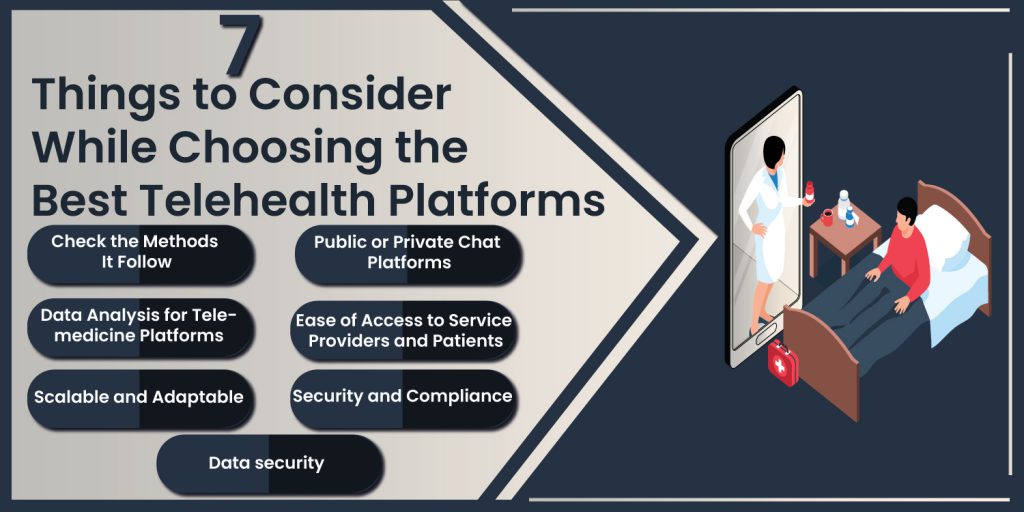
1. Check the Methods It Follows
Three main Telehealth integrations make a virtual healthcare platform the platform you want. Not all three are available on all of these HIPAA-compliant telehealth companies, but the patient must decide by choosing at least one type of integration on the remote health platform:
- Synchronous modality allows the patient to make a video or voice call appointment. The whole process takes place via a smartphone, tablet, or computer. Synchronous modality sometimes involves on-site patient monitoring using peripherals that another healthcare provider uses to send real-time updates to physicians.
- Asynchronous modality allows patients to send their images or clinical data through a portal that uses an instant messaging client. This type of modality does not use real-time connection methods. The doctor will look at the patient’s details later.
- Remote patient monitoring; through this method, the doctor receives the patient’s data either directly or stored, but remotely.
2. Data Security
The first consideration must be data security, and then the highest security you can find. When in doubt, don’t just use it. In the world, we are looking for PoPI and HIPAA (Health Insurance Portability and Accountability Act). Honestly, HIPAA is part of US regulation, and it may not apply to us, but this concerns real concerns about patient data and the avoidance of litigation instead of just following the law. In telehealth software platforms, video and text messaging are just two of the many things that are crucial for remote health security. Your patient’s name, email address, home address, phone number, and other things are all covered by the data and must be protected.
- Map Data: Find out where your data is available in the cloud.
- ASK & Apply: Who should have access to the data, access to data and the evidence of a business partnership agreement is required to ensure that all staff are at the same level as your solution provider.
- Monitor: All data access to your data.
- Setting Alarms: To notify you when someone has access to your data.
- Security: Ensure the solution has encryption, server room security, and two-factor authentication.
3. Public or Private Chat Platforms
There are a number of online video and group chat platforms on the market today. There is nothing against Zoom, Google Hangouts, Microsoft Teams, or WhatsApp or their colleagues, but data security is paramount in a healthcare environment. The vast majority of these platforms were made for reasons other than remote health and have therefore been adapted to suit a platform designed specifically for healthcare professionals on the move and in the modern world.
For instance, Zoom has become one of the most popular business meeting platforms today. Its free version and ease of use make it a quick choice for many healthcare practitioners. However, the question is whether it’s suitable for remote health consultations. The answer is no – Zoom’s free and standard paid versions are not HIPAA-compliant, which is why they’ve introduced Zoom for Healthcare. With a 12-month contract, the base rate starts at $200 per month, totalling approximately $3,400 per year. If you’re looking for a secure, compliant platform, you should be prepared to commit to such solutions long-term; telemedicine platforms are not typically used for just a few weeks.
Zoom was not originally for telemedicine platforms. It, therefore, did not have the features that remote healthcare technology trends have for online consultation or patient data storage. For this exact reason, Zoom was not originally to be HIPAA compliant. It has much more than just full encryption. HIPAA was established to protect patient privacy and ensure that patients have access to their medical records. PII (Personal Identifiable Information) is protected through the storage, transmission, and access of that information.
4. Data Analysis for Telemedicine Platforms
Although the data analytics used in the telehealth Platform does not directly affect patients, it does increase the overall performance of such systems. With a great background in data analytics, the telehealth platforms are always ready to deliver the ultimate patient care due to their strong grip on patient trends.
5. Security and Compliance
If your privacy and data are not secure, you may have to face a number of challenges. Telemedicine healthcare practices clearly define how to store and share patient information on their servers. Make sure your platform is HIPAA, PIPEDA, or PHIPA compliant and includes full encryption to prevent third parties from reading or accessing your private communications. As telehealth regulations still need some relaxation, it is time to be more vigilant about various remote health issues. Here are some of the threats your choice of telehealth platform should be able to protect you against.
- Cybersecurity and Data Risks
- Phishing
- Hacking
- Ransomware
- Compliance Risks
- Fraud Risks
- HIPAA risks
6. Ease of Access to Service Providers and Patients
The best telemedicine platform should be cross-compatible and can run seamlessly on any device, like a computer, smartphone, or tablet. The web browser and the operating system should work smoothly and reliably, no matter what device or browser you are using. In principle, the software should run as smoothly on older laptops as on the latest smartphones. The most feasible and easy-to-use platforms are the web and cloud. Web-based platforms make it easy to use the best telehealth platform on desktops, laptops, tablets, and smartphones. There is no requirement to install or download, and you can access it from any available Internet connection.
7. Scalable and Adaptable
Everything in the technological world changes every day, including the business size and revenue. When it comes to telehealth, no one wants to grow out of their telemedicine platform in just a year or two. Everyone wants a platform that scales as your organisation grows and that is adaptable as conditions change.
Looking for a Custom or White Label Telemedicine Platform?
We build secure, scalable telemedicine solutions for hospitals, clinics and startups – fully customized to your unique needs.
Contact UsConclusion
If you are thinking of employing or developing the best telehealth platform, this is the time. The current crisis has highlighted the importance of remote healthcare and provided an opportunity to modernise the system for providing care. This modernisation will be achieved by integrating television health into the continuity of care.
Telemedicine platforms are fruitful, and it’s easy to find a ready-made solution that a familiar company has used. However, existing telehealth platforms were created before the advancement of virtual care and were designed exclusively for businesses, healthcare systems, and private practices. To provide a complete maintenance experience, you may need to involve multiple vendors, allowing you to create custom solutions without creating your own. If you are in search of an efficient telehealth platform or solution, then VCDoctor has the perfect solution for you. They cover all the points discussed in the blog and much more. Experience optimum quality with VCDoctor for your medical practice.
FAQs
1. What does HIPAA compliance mean for telehealth platforms?
HIPAA compliance ensures that telehealth platforms for providers help them in protecting the privacy and security of patients’ health information. This includes implementing encryption, secure data storage, access controls, and adhering to other HIPAA regulations.
2. How can I verify if a telehealth platform is HIPAA compliant?
Look for platforms that explicitly state their HIPAA compliance status. They should provide details on encryption standards, data storage practices, and access controls, and may offer a Business Associate Agreement (BAA) that outlines their responsibilities under HIPAA.
3. What features should I look for in a HIPAA-compliant telehealth platform?
Essential features include secure video conferencing with end-to-end encryption, secure messaging, patient consent management, user authentication, and the ability to integrate with electronic health records (EHR) systems if needed.
4. Do all HIPAA-compliant telehealth platforms offer mobile accessibility?
Not all platforms offer dedicated mobile apps, but many do. It’s important to verify if the mobile app meets HIPAA requirements for secure communication and data storage.
5. Are there additional costs associated with HIPAA compliance on telehealth platforms?
Some platforms may charge extra for HIPAA compliance features or require additional fees for certain integrations or advanced security measures. It’s important to review pricing plans and understand what’s included in terms of HIPAA compliance.
6. What is the best telehealth platform?
The best telehealth platforms like Amwell, Teladoc, and Doxy.me, offer video visits and secure messaging with doctors, making it easy to get care remotely. Choose based on your needs for ease of use and provider availability.