
Top 12 ABDM Compliant HIMS Software in India (2026)
Choosing the right hospital management software in India is about more than managing appointments, billing, pharmacy, and patient records.
Today, your HMIS also needs to work with the Ayushman Bharat Digital Mission (ABDM). But this is where things can get confusing.
Many vendors say their software is “ABDM ready” or “ABHA integrated,” but that does not always mean the software has completed ABDM certification or supports all the required workflows.
That is why hospitals need to look beyond feature lists and marketing claims.
In this guide, we compare 12 ABDM-compliant HIMS software solutions in India based on their features, ABDM capabilities, deployment options, pricing, and ideal use cases.
You’ll also learn how to verify a vendor’s ABDM claims and choose the right solution for your hospital.
What Is ABDM Compliant HIMS Software?
ABDM compliant HIMS software is hospital management software that meets the National Health Authority’s ABDM requirements. It helps hospitals connect to India’s digital health network.
ABDM can manage OPD, IPD, pharmacy, lab, billing, and patient records. Also, it creates and links ABHA numbers and shares health records with other connected facilities when the patient gives consent.
Not every HMIS that says “ABDM ready” is fully compliant. The key is to check what ABDM features and certifications the software actually supports.
ABDM Milestones M1, M2, M3 and M4 Explained
The National Health Authority certifies software in stages rather than all at once. Each milestone unlocks a different capability, so a vendor can honestly claim ABDM integration while sitting at the first stage.
Understanding ABDM M1, M2, and M3 certification is the most useful thing a buyer can learn before demos start. It decides what your software can actually do.
| Milestone | What It Certifies | What Your Facility Can Do |
|---|---|---|
| M1 | ABHA creation, verification and linking | Register patients with a verified national health ID |
| M2 | Health Information Provider (HIP) | Link care contexts and share records on consent |
| M3 | Health Information User (HIU) | Pull patient history from other connected facilities |
| M4 | NHCX claim exchange | Submit and track digital insurance claims |
- M1: ABHA Creation & Linking: Creates and verifies ABHA numbers and links patients to their digital health identity.
- M2: Share Health Records: Helps hospitals link and share consultations, lab reports, and discharge summaries with patient consent.
- M3: Access Health Records: Allows doctors to request and view a patient’s health history from other connected hospitals and labs with consent.
- M4: Digital Insurance Claims: Supports digital insurance workflows, including pre-authorisation, claim submission, and claim status tracking.
Why ABDM Compliant HIMS Software Is No Longer Optional for Indian Hospitals
The network has passed the point where a hospital can wait it out. India has created more than 93.95 crore ABHA numbers and linked over 105 crore health records, according to the Ministry of Health and Family Welfare.
Alongside that, 5.33 lakh facilities and 9.85 lakh professionals sit on the national registries, and around 2.72 lakh facilities already run ABDM-enabled software.
Here is what compliance changes on the ground:
- Government Empanelment and PMJAY Access: ABDM-enabled systems can help hospitals meet digital health requirements linked to government schemes and PMJAY workflows.
- One Patient Identity: ABHA gives each patient a verified digital health identity, helping reduce duplicate patient records across departments and visits.
- Faster OPD Registration: With Scan and Share, patients can scan a QR code and share their details, making registration faster and easier.
- Better Patient History: Doctors can access a patient’s linked health records, such as previous reports and consultations, when the patient gives consent.
- Fewer Repeat Tests: Easy access to previous reports can help reduce unnecessary repeat tests and save time for both patients and hospitals.
- Simpler Insurance Claims: Structured digital records can make it easier to prepare and manage insurance claims with fewer missing documents and data errors.
- Better Data Tracking: ABDM workflows, consent records, and access logs can help hospitals track how patient data is used and support better data management.
Quick Answer: Top 12 ABDM Compliant HIMS Software in India at a Glance
Here is the shortlist. Use it to narrow twelve options down to three worth demoing, then read the details under each one.
| Platform | Best For | Deployment | ABDM Coverage | Standout Strength |
|---|---|---|---|---|
| VCDoctor | Hospitals and groups wanting their own branded platform | Cloud, private cloud or on-premises | M1 to M3 plus HFR, HPR, UHI and consent manager | White-label HMIS that also retrofits ABDM onto your current system |
| DreamSoft4U | Hospitals and healthtech platforms wanting a custom-built HMIS | Cloud, on-premise or hybrid | M1 to M3 plus NHCX claim exchange | ABDM connector live in as little as one week |
| Doctors App | Clinics and hospitals prioritising fast documentation | Cloud | M1, M2 and M3 | AI prescriptions with voice and stylus input |
| Healthixio | Clinics up to 500-bed hospitals wanting one system | Cloud only | Officially integrated, ABHA and record linking | Front-desk ABHA workflow built into registration |
| KareXpert | Large hospital groups running a full rollout | Cloud | Supported across the national health stack | Zero-footprint cloud HIS with revenue cycle depth |
| Insta by Practo | Multi-branch and multi-country hospital groups | Cloud SaaS | Supported | Configurable EMR forms across many centres |
| MocDoc | Growing hospitals and clinic chains | Cloud | Supported | Integrated LIMS and pharmacy with barcode tracking |
| Healthray | Mid to large hospitals wanting AI-assisted operations | Cloud | ABDM compliant, NHA approved | Predictive analytics and live bed management |
| HealthPlix | Solo doctors and OPD-heavy clinics | Cloud | ABHA aligned, EMR scope | Prescriptions in roughly 30 seconds across 14 languages |
| Medixcel | Large hospitals and diagnostic chains | Cloud | Supported | Deep lab and radiology departmental coverage |
| Aarogya by Dataman | Legacy, teaching and government hospitals | On-premise or cloud | ABDM certified | 20+ modules with a long delivery record |
| Bahmni | Public, charitable and resource-constrained facilities | On-premise | Community-supported ABDM connectors | Open source with no licence fee |
Looking for an ABDM-Compliant HIMS?
Explore VCDoctor’s complete HIMS with ABDM integration, EMR/EHR, billing, pharmacy, lab, and hospital management modules.
Book a Free HIMS Assessment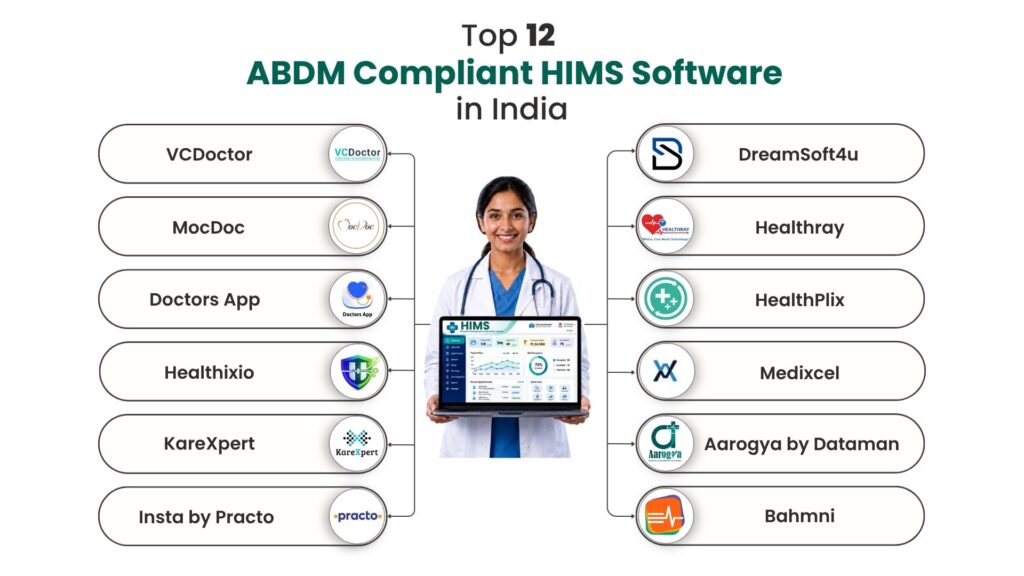
Let’s explore each one in detail.
1. VCDoctor
VCDoctor is a white-label hospital management and telehealth platform for facilities that want the system to carry their own brand. It runs 25 integrated modules across patient access, clinical care, diagnostics, revenue cycle, and administration, all on one shared patient record.
What separates it from everything else here is the second delivery path. VCDoctor supplies a complete HMIS, or it plugs ABDM into the EHR you already run without rebuilding your clinical workflows. That matters when a hospital has invested years in a system that works but has no compliance route.
Its ABDM scope runs end to end. That covers ABHA creation and linking, PHR app integration, HIP and HIU modules, and UHI connectivity. It also handles FHIR R4 record structuring, HFR and HPR registration, and consent manager integration.
Sandbox certification typically completes in four to eight weeks, with production go-live in eight to twelve weeks.
If your current system works well but lacks ABDM compliance, VCDoctor can add ABDM support without replacing the entire system.
- Best for: Multi-specialty hospitals, hospital groups, diagnostic chains, government facilities, and healthtech startups needing a branded platform or an ABDM retrofit.
- Standout ABDM capability: Full M1 to M3 coverage delivered either as a new platform or as a layer on your existing system.
- Deployment: Cloud, private cloud, or on-premises, with data residency configured to your rules.
- Beyond India: Six regulatory frameworks on one build, covering ABDM and DPDP for India plus HIPAA, NABIDH, DHA and GDPR for international operations.
Book a free VCDoctor demo and get your ABDM compliance gap scoped before you shortlist anyone else.
2. DreamSoft4u
DreamSoft4u is the healthcare engineering company behind VCDoctor, with 22+ years in healthcare IT, 1,600+ projects delivered and 100+ engineers. Where VCDoctor gives you a ready platform, DreamSoft4u engineers a custom HMIS shaped around your own departments and workflows.
Its ABDM integration services also run as a standalone connector for existing systems. Nine simplified APIs replace more than 40 native ones, and your platform inherits M1 to M3 compliance. A separate NHCX connector then handles digital insurance claims.
- Best for: Hospitals, EMR vendors and healthtech platforms that want a custom-built HMIS or a fast connector route to ABDM and NHCX.
- Standout ABDM capability: A pre-certified connector that can take an existing platform live on ABDM in as little as one week.
- Where it falls short: A fully custom HMIS takes months to scope and build. Facilities that need a ready system this week are better served by an off-the-shelf product.
3. Doctors App
This app built its reputation on documentation speed. Doctors dictate by voice or write with a stylus, and the system converts input into structured records across 30+ speciality templates. ABHA creation sits inside the app, with coverage across M1, M2, and M3.
- Best for: Clinics and small to mid-size hospitals where consultation throughput is the bottleneck.
- Standout ABDM capability: In-app ABHA creation tied directly to AI-assisted prescribing.
- Where it falls short: Enterprise administration, HR, and asset modules are lighter than dedicated hospital suites offer.
4. Healthixio
Healthixio takes a front-desk-first approach to compliance. ABHA creation is embedded in a registration flow built for high-volume Indian OPDs. The platform covers OPD, IPD, EMR, pharmacy, pathology, billing, TPA, and MIS across roughly 15 modules, serving 500+ hospitals in 110+ cities.
- Best for: Clinics through to 500-bed multi-speciality hospitals wanting one cloud system.
- Standout ABDM capability: Registration-desk ABHA workflow that hits record-linking volume consistently.
- Where it falls short: Cloud-only, with no radiology PACS or blood bank module, which rules it out for facilities needing either.
5. KareXpert
KareXpert targets the top of the market with a zero-footprint cloud hospital information system. Hospitals run clinical workflows and revenue cycle management on one platform without maintaining servers. The product is built for phased rollouts across large groups with complex approval chains.
- Best for: Large hospital chains and enterprise groups ready for a structured, multi-site implementation.
- Standout ABDM capability: National health stack connectivity designed to scale across many facilities at once.
- Where it falls short: Implementation weight and cost make it disproportionate for a single nursing home or clinic.
6. Insta by Practo
Insta serves hospital groups operating across branches and, in some cases, across countries. Its strength is configurability. EMR forms, report templates, and workflows can be shaped per centre while management still gets consolidated reporting at group level.
- Best for: Multi-branch and multi-country hospital groups needing consistency without rigidity.
- Standout ABDM capability: ABDM workflows layered onto an established multi-centre SaaS platform.
- Where it falls short: Pricing scales with users and locations, pushing it beyond reach for smaller single-site facilities.
7. MocDoc
MocDoc is the practical pick where diagnostics and dispensing carry as much weight as consultation. Its laboratory and pharmacy modules are genuinely integrated rather than bolted on, with barcode-driven sample tracking and batch-level stock control feeding the same patient record.
- Best for: Growing hospitals and clinic chains running their own lab and pharmacy.
- Standout ABDM capability: Lab reports and prescriptions link to ABHA as part of the normal workflow.
- Where it falls short: Enterprise reporting and analytics are thinner than the large hospital platforms provide.
8. Healthray
Healthray leans into operational intelligence. Alongside standard hospital modules, it runs predictive analytics, billing audits, and real-time bed management. Administrators get live visibility into occupancy and revenue leakage instead of waiting for a monthly report.
- Best for: Mid to large hospitals where management wants operational data daily, not at month-end.
- Standout ABDM capability: ABDM workflows paired with automated data quality checks on linked records.
- Where it falls short: The analytics depth only pays back at reasonable patient volume, so small facilities underuse it.
9. HealthPlix
HealthPlix is not a full HMIS and does not pretend to be. It is a doctor-first EMR optimised around one job. That job is producing a complete, coded prescription in roughly 30 seconds, across 14 Indian languages, with clinical decision support prompting as the doctor types.
- Best for: Solo practitioners and OPD-heavy clinics with no inpatient operations.
- Standout ABDM capability: ABHA-aligned clinical documentation that stays fast enough for real consultation pace.
- Where it falls short: Administration, inpatient, inventory, and revenue cycle functions sit outside its scope entirely.
10. Medixcel
Medixcel covers departments in depth, particularly on the diagnostic side. Laboratory and radiology integration, patient portals and teleconsultation run alongside core hospital operations. That suits organisations where imaging and pathology are revenue centres rather than support functions.
- Best for: Large hospitals and diagnostic chains with significant imaging and lab volume.
- Standout ABDM capability: Diagnostic reports structured for record linking at the point of validation.
- Where it falls short: Configuration effort is higher, and connectivity-dependent workflows strain in low-bandwidth locations.
11. Aarogya by Dataman
Aarogya is the option most often shortlisted when cloud is off the table. Its vendor has a delivery record stretching back decades, and the product offers 20+ modules in client-server or cloud form. That keeps it relevant for teaching hospitals and institutions with strict residency mandates.
- Best for: Legacy, teaching and government hospitals with in-house IT and on-premises requirements.
- Standout ABDM capability: ABDM certification available on a locally hosted deployment.
- Where it falls short: The interface and release cadence feel dated next to cloud-native competitors.
12. Eka Care
Eka Care approaches the problem from the patient’s side first. It built an ABDM-native experience around ABHA creation and personal health record access, then extended into clinic tools. The result is strength in identity and record availability rather than hospital operations.
- Best for: Clinics and facilities that want patients actively engaging with their own linked records.
- Standout ABDM capability: Native ABHA and PHR handling built into the product from the start.
- Where it falls short: Inpatient, pharmacy, inventory, and revenue cycle depth is limited for hospital use.
12. Bahmni
Bahmni is the open-source entry, assembling clinical records, laboratory, and pharmacy into one system with no licence fee. It is genuinely capable and widely deployed in low-resource settings. The trade-off is straightforward: you exchange software costs for engineering effort.
- Best for: Public, charitable and NGO-run facilities with access to technical support.
- Standout ABDM capability: Community-built ABDM connectors that can be extended to your own requirements.
- Where it falls short: You own the integration, certification, and maintenance burden, which most private hospitals cannot staff.
Also Read: ABDM vs HFR vs HPR: Everything You Need to Know
What ABDM Compliant HIMS Software Costs in India
Pricing in this market is almost entirely quote-based, which makes comparison hard. The ranges below reflect what Indian vendors publish or quote most often, and they give you a defensible starting point for negotiation.
| Facility type | Common pricing model | Indicative range | What usually sits outside the quote |
|---|---|---|---|
| Single clinic or small practice | Flat monthly per facility | ₹1,500 to ₹5,000 per month | ABDM module, SMS credits, data migration |
| Nursing home, 10 to 80 beds | Flat monthly or per user | ₹5,000 to ₹15,000 per month | Training, additional modules, custom reports |
| Mid-size hospital, 80 to 250 beds | Per bed or per module | ₹15,000 to ₹60,000 per month | Integrations, on-site support, analyser interfaces |
| Large hospital or group | Enterprise licence or subscription | ₹2 lakh to ₹25 lakh upfront | 15% to 20% annual maintenance, customisation |
| On-premise deployment | Perpetual licence plus AMC | Upfront licence plus server cost | Hardware, backups, in-house IT staffing |
Hidden Costs to Check Before Signing
- Data Migration: Check whether moving your existing patient and hospital data is included in the price.
- Staff Training: Confirm how many training sessions are included and whether extra sessions cost more.
- SMS & WhatsApp Credits: Ask about message limits and charges for additional messages.
- Annual Maintenance: Check the yearly maintenance and support fees after the first year.
- Custom Reports: Confirm whether custom reports or changes to existing reports cost extra.
- Data Export: Ask if you can export your data for free when switching to another system.
- Extra Modules & Integrations: Check for separate charges for additional modules, third-party tools, and integrations.
Also Read: ABDM Doctor Incentives: Benefits, Eligibility and How to Get Started
How to Choose the Right ABDM Compliant HMIS Software for Your Facility
Choosing an HMIS becomes easier when you follow a simple process. Use these seven steps to compare vendors, check ABDM support, and find software that fits your hospital.
Step 1: Map Your Departments and Requirements
List all departments that will use the software, such as OPD, IPD, lab, pharmacy, billing, and accounts. Mark which features are essential and which are optional. This gives you a clear checklist to use during vendor demos.
Step 2: Decide Which ABDM Milestones You Need
Understand whether your facility needs M1, M2, M3, or M4. For example, M1 and M2 may be enough for some labs, while multi-specialty hospitals may also need M3. Choose based on your actual needs.
Step 3: Verify Vendor Certification
Ask vendors which ABDM milestones their software has completed and whether it is live in production. Get the details in writing and ask for a reference from a similar hospital that is already using the system.
Step 4: Choose Your Deployment Model
Decide whether you need cloud, private cloud, hybrid, or on-premise software. Cloud systems are easier to manage, while on-premise options may suit hospitals with specific data or IT requirements.
Step 5: Run a Real Workflow Demo
Do not rely only on a standard product demo. Ask the vendor to show a real patient journey, from ABHA creation and consultation to lab tests, billing, and consent-based record sharing. This helps you see how the system works in practice.
Step 6: Compare the Total Cost
Look beyond the monthly or yearly licence price. Include implementation, data migration, training, maintenance, integrations, SMS, and other extra costs. Compare the total cost over at least three years.
Step 7: Check Data Ownership and Contract Terms
Before signing, confirm that your hospital owns its data and can export it when needed. Also check uptime, support response times, maintenance costs, and who will handle future ABDM updates and integration changes.
Why VCDoctor Leads This List of ABDM Compliant HIMS Software
VCDoctor sits at the top of this list for one reason no other platform here matches. It gives you a complete branded hospital management system, or it plugs ABDM into the system you already run, and you choose which.
- Full milestone coverage: ABHA creation and linking, PHR integration, HIP and HIU modules, UHI connectivity, FHIR R4 structuring, HFR and HPR registration, and consent manager integration as one programme.
- Retrofit without a rebuild: We map your existing EHR or hospital system and add compliance on top, so staff keep their workflows and your go-live date stops depending on another vendor’s roadmap.
- 25 modules under your brand: Patient access, clinical care, diagnostics, revenue cycle, and administration on one shared record, shipped as a white-label platform with your own logo and domain.
- Deployment on your terms: Cloud, private cloud, or on-premises, configured to your data residency rules rather than ours.
- Six regulatory frameworks, one built: ABDM and DPDP for India, plus HIPAA, NABIDH, DHA and GDPR for facilities with international operations or medical tourism volume.
- Predictable compliance timeline: Sandbox certification typically in four to eight weeks and production go-live in eight to twelve, with scope fixed from day one.
- Proven in production: 50+ white-label healthcare products live, spanning oncology teleconsultation and multi-specialty deployments across India and international markets.
Ready to Choose the Right ABDM-Compliant HIMS?
Get a personalized walkthrough of VCDoctor’s HIMS and see how it can fit your hospital’s workflows and ABDM requirements.
Contact Us TodayConclusion
Choosing the right ABDM-compliant HIMS software is about finding a system that fits your hospital’s needs, budget, and workflows.
Before making a decision, check the ABDM milestones, verify the vendor’s certification, compare the total cost, and test the software with real hospital workflows.
Whether you upgrade your existing HMIS or move to a new platform, make sure the solution can support your hospital as your needs grow.
A good HMIS should not only manage daily hospital operations but also help you connect with India’s growing digital health ecosystem.
Need Help With ABDM Integration? Talk to our experts, and we can help you assess your current HMIS, identify ABDM gaps, and choose the right integration approach.
FAQs
ABDM compliant hospital management software has cleared National Health Authority milestone testing. It creates ABHA numbers, links care contexts, and exchanges records under consent. Supporting FHIR alone does not qualify, because ABDM applies its own India-specific profiles.
It is not universally mandatory yet, though several states are moving towards requiring it. Government empanelment and PMJAY participation increasingly depend on it, so most facilities now treat compliance as expected rather than optional.
M1 covers ABHA creation and patient identity verification. M2 makes your software a Health Information Provider that shares records on consent. M3 makes it a Health Information User that pulls history from other facilities, and a full-service hospital realistically needs all three.
Yes, and it is often the faster route. An integration layer sits above your current system, adding ABHA creation, care context linking, and consent handling without replacing clinical workflows. This usually costs less than a full migration, provided your existing system is operationally sound.
Sandbox certification typically runs four to eight weeks with an experienced team, followed by production go-live in another eight to twelve weeks. Multi-site hospital groups take longer because identity reconciliation and site-by-site rollout add sequencing work.
Small clinics commonly pay ₹1,500 to ₹5,000 per month and mid-size hospitals ₹15,000 to ₹60,000. Large groups move into enterprise licensing from ₹2 lakh upwards, with migration, training, integrations, and maintenance sitting outside most headline quotes.