
What is the Future of AI in Telemedicine?
AI in telemedicine is now a major topic of discussion worldwide. People want to know how it will shape the future of virtual healthcare. Since the pandemic, the healthcare industry has been evolving at a massive pace and introducing the latest technologies to improve patient care. Since the invasion of technology, almost every industry is relying on artificial intelligence to improve its work and efficiency. Therefore, people want to know what the future of AI in telemedicine software is. Talking about the functionality of AI in telemedicine, it will definitely enhance the efficiency of healthcare facilities, providing support to the patients and support to the doctors.
Whereas it also depends on the functionality and software development process in which AI is integrated and how it can automatically enhance its learning capabilities. So let’s understand the future of AI in telemedicine and how it is different from old school methods of medical diagnosis and support.
Earlier, doctors conducted personal consultations to provide healthcare services. Nowadays using Telemedicine it is very easy to consult doctors from faraway places and even in the absence of a doctor, AI can assist the patient. However, it has some limitations in medical care that involve surgeries and operations, but the latest variable technologies and tools are eliminating these barriers.
Table of Contents
- An Introduction To Telemedicine
- Future of AI in Telemedicine
- Role of AI in Telemedicine
- What is the Use of AI in Telemedicine Solutions?
- Benefits of AI in Telemedicine
- Challenges of AI in Telemedicine
- AI in Telemedicine Future
- How Can VCDoctor Help You with AI Adoption in Telemedicine?
- Conclusion
- FAQs
- 1. What are the top features of telemedicine software?
- 2. Mention how telemedicine is different from telehealth?
- 3. How are healthcare experts using telemedicine software?
- 4. Are there any challenges that patients experience due to telemedicine software?
- 5. Mention the telemedicine software development cost?
An Introduction To Telemedicine
Telemedicine is a software to deliver medical services remotely. Using this software, doctors can diagnose patients from the comfort of home. Based on the patient’s health condition, a tailored treatment plan is suggested. Video conferencing is an integral part of all of this as it allows doctors to closely examine patients via camera. Through video conferencing, doctors can virtually diagnose patients and understand their body language. There are several other benefits of Telemedicine software. This also reduces travel time and lowers medical costs. Hence, the future of telemedicine is bright and promising.
Future of AI in Telemedicine
Telemedicine is going through a dramatic change enabled by AI, to improve diagnostic accuracy. As it individualizes care and operates more effectively. AI helps doctors work with less manpower, analyzing the data on the patients faster and with fewer mistakes. Moreover, it also helps provide a more precise, data driven treatment plan. This technology also helps with monitoring patients, to the extent that monitoring devices connected to them alert doctors when something changes in a patient’s health in real time. AI is good news for patients in terms of the speed of diagnosis, the accuracy of diagnosis, and personalized healthcare advice, all based on individual needs and health history.
Finally, AI powered healthcare chatbots and virtual assistants are instantly available to answer common patient questions and reduce wait times. As AI continues to evolve, telemedicine is expected to become more accessible and affordable, helping bridge gaps in healthcare delivery and improve outcomes across diverse populations. The future of AI in telemedicine is shaping up to be a hybrid model that is more connected, more efficient, and strongly focused on patient needs.
Role of AI in Telemedicine
AI in telemedicine optimizes resource allocation. They also predict potential health challenges. It is vital in telemedicine as it offers innovative solutions to streamline processes. It also enhances patient care. This integration has completely transformed the healthcare industry, making patient care more personalized and accessible.
Due to AI in telemedicine, geographical barriers are removed as personalized care is accessible to all. Patients can easily contact doctors using AI-driven telemedicine software for the best healthcare services.
The emergence of AI and telemedicine also allows for the rapid detection of potential health problems. In all, AI in telemedicine is a blessing in disguise as it is making healthcare services accessible in a way that they were never available. As a result, the international market size of AI technologies in the healthcare industry is expected to increase from $11 billion in 2021 to nearly $188 billion by 2030.
Have Questions About Telemedicine or AI?
Chat with us on WhatsApp and get expert advice instantly.
Talk to Our ExpertsWhat is the Use of AI in Telemedicine Solutions?
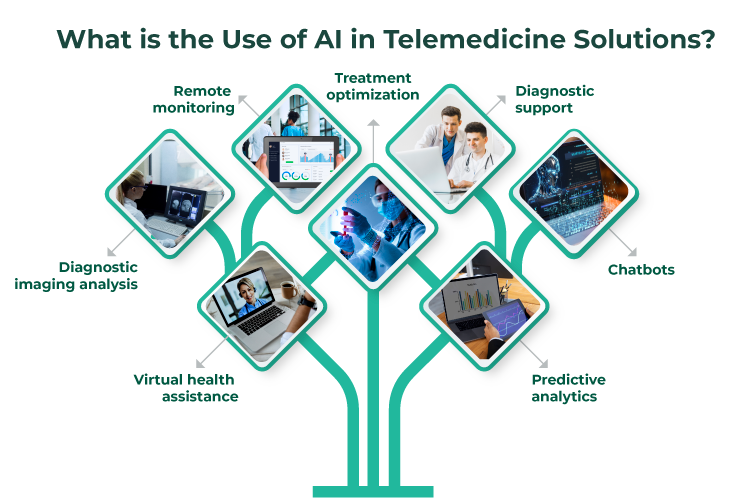
1. Remote Monitoring
Wearable gadgets and sensors combined with AI provide continuous remote monitoring of patients’ health indicators. Remote patient monitoring software integrates with these devices to collect real-time data on vital signs, activity levels, and other key health parameters. This allows healthcare professionals to remotely track patients’ conditions and take immediate action when needed. As a result, such technology is shaping the future of telehealth and will have a significant impact on the healthcare industry.
2. Diagnostic Imaging Analysis
Special aspects of using AI in telemedicine can include the interpretation of complicated medical images such as CT scans, X-rays, MRI scans, etc to enable the doctors to diagnose the problems quickly and effectively. This remote capability offers those in practice an opportunity to deliver timely diagnosis to patients without necessarily having to travel, especially from rural or underserved areas. In other words, through diagnosing the root causes early, AI shortens the treatment time thereby improving general patient care.
3. Virtual Health Assistance
Virtual health assistants powered by AI can also speak to patients who are in need of explanations, clarifications or simply what action they should take next regarding their health. They also give out individualized messages for clients to take their medicines, forget appointments or adopt healthier lifestyles. Therefore, it increases compliance with treatment regimes. With such continued support, those who are taken through this program gain better engagement, therefore, better health and more preventive health care.
4. Predictive Analytics
Large patient data sets are analyzed by AI systems to find trends and forecast health hazards. Using predictive analytics, telemedicine future solutions can stratify patients according to their risk profiles. This allows for tailored preventative care regimens and proactive interventions. This method lowers healthcare expenses, enhances patient outcomes, and aids in the early identification of possible health problems.
5. Chatbots
Telehealth management and appointment scheduling are manageable on the doctor’s end. Now the AI bot manages the patient crowds with the help of AI-automated solutions and provides solutions to the patients’ queries. These answer the routine questions in real time, hence improving satisfaction among the patients. Furthermore, through the use of chatbots, doctors get to know the data of the patient and thereby come up with better decisions necessary in the enhancement of healthcare facilities.
6. Diagnostic Support
Doctors and healthcare professionals have access to AI-powered diagnostic tools that enable precise remote diagnosis of medical disorders. To find any anomalies, machine learning algorithms thoroughly examine medical pictures from MRIs, CT scans, and X-rays. It allows the radiologist to find more accurate results faster.
7. Treatment Optimization
AI thoroughly examines patient medical histories and clinical guidelines in telemedicine to provide individualized treatment regimens. The patient’s medical history, genetic composition, lifestyle choices, and preferences all play a role in these suggestions. Moreover, tailored treatment programs are created to fulfil each patient’s requirements.
Read Also: AI in Healthcare: Features, Benefits, Use Cases, and Future Trends
Benefits of AI in Telemedicine
The top benefits of AI in telemedicine include:
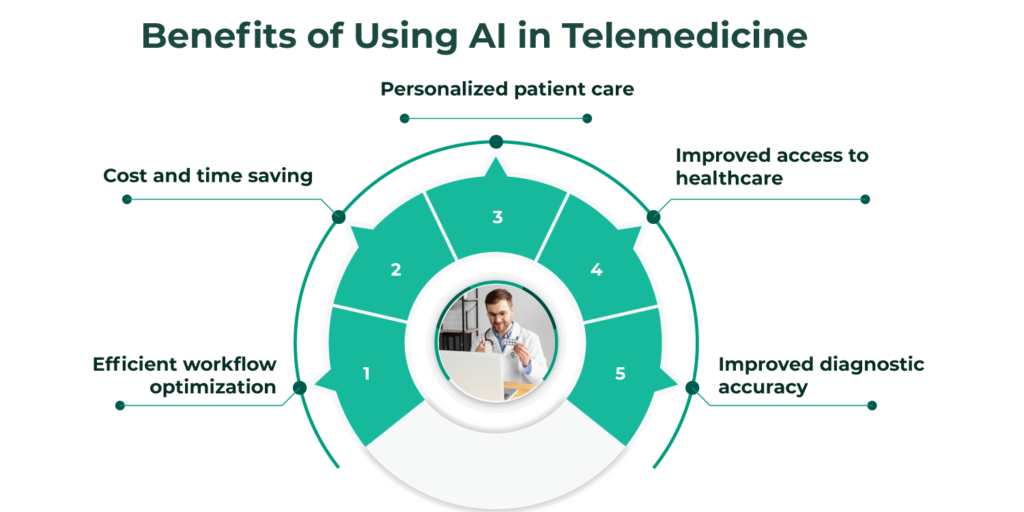
1. Personalized Patient Care
The medical industry deals with huge chunks of data every day. Due to the vast amount of data, the chances of errors exist. As a result, patients fail to get accurate medical services. AI algorithms have access to your medical history and lifestyle patterns already. It allows them to make informed decisions that improve patient satisfaction.
2. Improved Access to Healthcare
AI in telemedicine has no geographical barriers. Thus, the best healthcare services are accessible to all! This improves access to healthcare services. It is especially beneficial for unreserved and rural areas. In the case of telemedicine urgent care, this software comes in handy.
3. Improved Diagnostic Accuracy
In the healthcare industry, mistakes can occur anytime and anywhere. This increases the chances of patient complications. With AI in telemedicine, doctors can make accurate diagnoses through deep learning techniques. AI closely reads patients’ data and improves patient outcomes.
4. Cost and Time Saving
Telemedicine software saves a lot of time as it eliminates the need for personal visits. Additionally, you can get answers to your queries online. Further, there is no need for repetitive diagnostic tests, making healthcare cost-friendly.
5. Efficient Workflow Optimization
Artificial intelligence improves operational efficiency and resource usage in telemedicine today’s systems by streamlining clinical workflows and administrative chores. AI-powered systems streamline healthcare service delivery. Above all, they allow doctors to focus on patients’ health improvement.
Need a Custom AI Virtual Care Solution?
Book a live demo and explore how VCDoctor works for your needs.
Schedule a Meeting NowChallenges of AI in Telemedicine
Here are some common challenges of artificial intelligence in telemedicine:
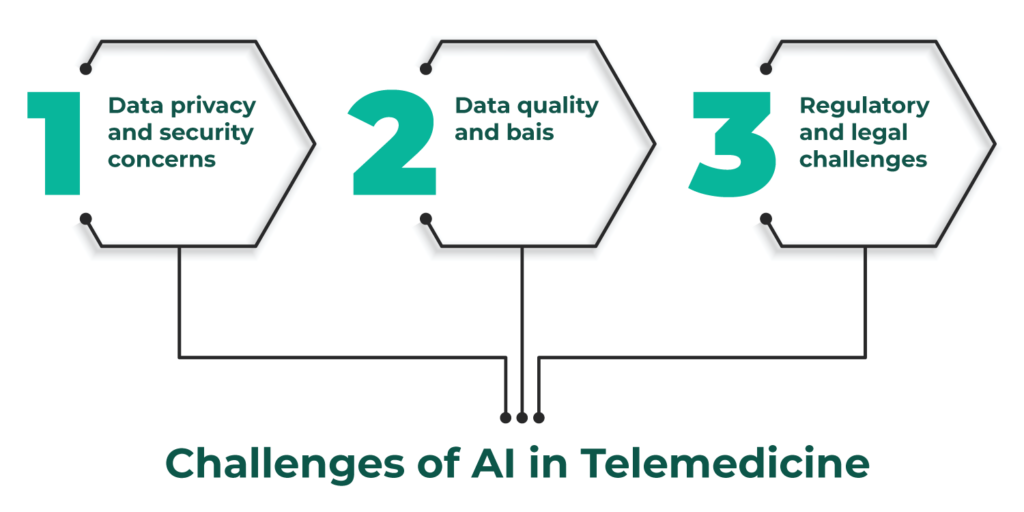
1. Data Privacy and Security Concerns
Telemedicine platforms deal with sensitive patients’ medical records. Maintaining the privacy of this information is important to maintain patients’ trust. However, certain AI systems are not designed with the best security measures. This increases the chances of data breaches. To avoid this, choose a service provider following regulatory requirements such as HIPAA.
2. Data Quality and Bias
Large datasets are an integral part of the healthcare sector. Any discrepancy or bias in the data results in inaccurate predictions. It can hamper the entire diagnosis and treatment procedure. Therefore, it is vital to check that the data is correct. Excellent data quality must be guaranteed to reduce bias in AI-driven telemedicine solutions.
3. Regulatory and Legal Challenges
Regulations and legal requirements for telemedicine practices may differ throughout jurisdictions. Incorporating artificial intelligence (AI) into telemedicine poses intricate legal and regulatory issues concerning medical standard compliance, liability, licensure, and payment. Tech developers and healthcare practitioners must navigate these regulatory environments to guarantee AI’s moral and right application in telemedicine.
AI in Telemedicine Future
AI can effectively transform the telemedicine sector to improve diagnostic precision. It facilitates remote monitoring. Through telemedicine, remote medical care has become more accessible. It has numerous advantages, like making healthcare easier to access. Other benefits include providing immediate medical attention and easing financial burdens.
According to experts, AI has the power to reduce healthcare inefficiencies. Many AIs in healthcare can improve patients’ experience and overall workflow. Although AI is complex in telemedicine, with proper advancements, these challenges can be tackled easily. Thus, it can be concluded that the future of AI in healthcare is exceptional.
How Can VCDoctor Help You with AI Adoption in Telemedicine?
VCDoctor supports AI adoption in telemedicine by integrating advanced technologies into its platform. As a leading telemedicine app development company, it uses AI to streamline patient scheduling and manage medical records efficiently. The AI assists users by providing accurate diagnostics through image and data analysis. It also enhances virtual consultations with real-time language translation and sentiment analysis.
This improves communication between patients and doctors. VCDoctor AI offers personalized treatment recommendations based on patient history and health data. It ensures data security and compliance with healthcare regulations through intelligent monitoring. Users benefit from faster service, better accuracy, and higher care quality. The platform makes AI tools easy to use, even for those with limited technical skills. Overall, VCDoctor empowers healthcare providers and patients by leveraging AI to enhance telemedicine experiences.
Conclusion
The future of AI in telemedicine is bright and transformative. There’s no doubt that AI will enhance patient care with accurate diagnostics and personalized treatments. It will simplify administrative tasks, allowing doctors to focus on patients. Advanced AI will improve disease prediction and prevention. Telemedicine platforms will offer seamless virtual consultations and real-time language translation.
AI tools will ensure data security and compliance, building user trust. However, with the evolving technology AI will make telemedicine more accessible and efficient. It will ultimately lead to better healthcare outcomes and a stronger healthcare system.
Looking for AI-driven Telemedicine Solutions?
Talk to our experts about features, pricing and implementation.
Contact UsFAQs
1. What are the top features of telemedicine software?
In telemedicine software, multiple features make it easier for patients and doctors to interact easily. Out of all, real-time communication and appointment scheduling are the two most important. It also has features like prescription management, video conferencing for remote consultation, secure patient data storage, and others. All these features enhance the software’s credibility.
2. Mention how telemedicine is different from telehealth?
Both these terms are sometimes used interchangeably. However, both have a slight difference. Telemedicine refers to remote medical services. However, telehealth is a broad term that covers both remote non-clinical and medical services.
3. How are healthcare experts using telemedicine software?
Today, telemedicine software is used widely by healthcare experts. On the software, you get complete information about patients. Additionally, patients can easily schedule appointments and meet healthcare providers virtually. During the consultation, a video conferencing feature is used for detailed diagnosis and real-time communication. This makes healthcare services accessible to all.
4. Are there any challenges that patients experience due to telemedicine software?
Yes, while using the telemedicine software, patients experience certain challenges. Out of all, one major challenge is the inability to use the software. You must have a proper understanding of using AI enabled telemedicine software. Additionally, you should have a stable internet connection so that the consultation can take place smoothly. Additionally, you have an excellent mic and a webcam.
5. Mention the telemedicine software development cost?
The total cost completely depends on the service provider. If you choose advanced features, the cost will increase.